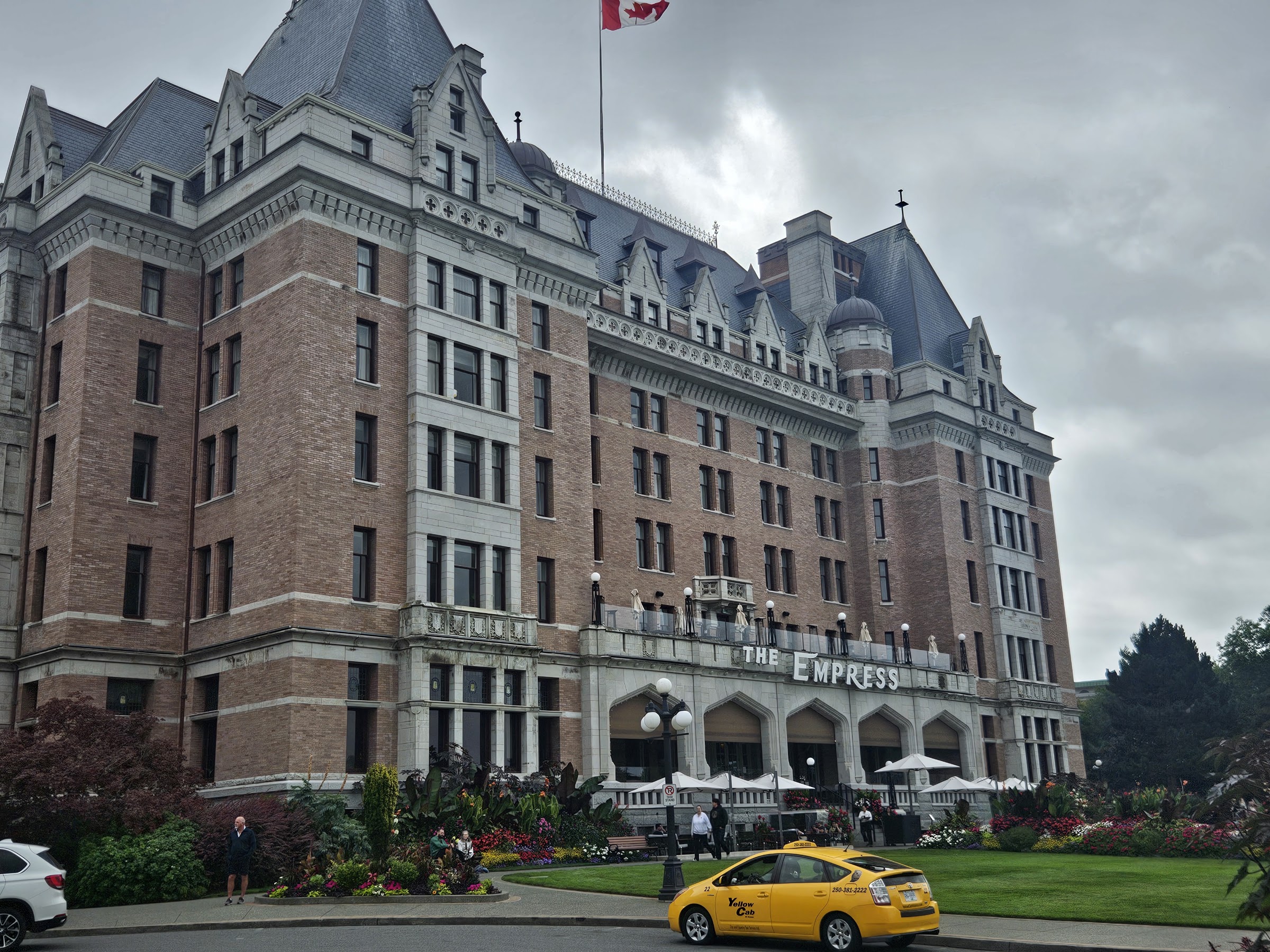
Some trips are yours and some belong to the person you’re traveling with. This one was Leigh’s. Her parents stopped in Victoria on a cruise about thirty years ago, came home talking about Afternoon Tea at the Empress, and the idea took root and never left. So when our Alaska sailing ended in Vancouver in September 2026, the rest of our party flew home and the two of us kept going — across the Strait of Georgia by floatplane for three nights on Vancouver Island. Bucket list, checked, with the tea to prove it.

Getting there is half the fun: Vancouver Harbour to Victoria Harbour
Harbour Air flies downtown-to-downtown. You walk off the ship at Canada Place, roll your bags about five minutes to the terminal at 1055 Canada Place, and thirty-five minutes later you are stepping onto a float in Victoria’s Inner Harbour, five minutes from the Empress front door. The same trip by ferry and bus is most of a day. Ours was a de Havilland DHC-3 Turbo Otter — a 1950s airframe with a turbine on the nose, which is the aviation equivalent of a small-block V8 in a hot rod — and there is no security theater, no jet bridge, no seatbelt sign. Just a dock, a load sheet, and a pilot who hands you earplugs.
As a pilot I’d have paid the fare just for the cockpit view. As a passenger, the payoff is the Gulf Islands sliding underneath at 1,000 feet: sailboats in the passes, log booms, ferry wakes, and the tide lines you never see from 35,000.


Staying at the Empress
A bucket-list trip sometimes insists on the full version, so we splurged on two nights in the Empress rather than just visiting for tea, then finished with a free-night voucher at the Marriott Inner Harbour a few hundred yards away. The hotel opened January 20, 1908, designed by Francis Rattenbury — the same architect responsible for the Parliament Buildings across the water — as one of Canadian Pacific’s château-style railway hotels, and it has been the anchor of Victoria’s harbour ever since. It is a national historic site that still functions as a hotel, which is a harder trick than it sounds.
Just outside, sitting on the ground rather than on a plinth, is Our Emily — Barbara Paterson’s larger-than-life bronze of the painter Emily Carr, sketchbook in hand, her monkey Woo on her shoulder and her dog Billie at her feet, unveiled in October 2010. It is designed to be touched and stood beside, and everyone does.


Lunch in a bank: Bard & Banker
First lunch was at Bard & Banker on Government Street — a local brew and a Montreal smoked meat sandwich in a room with a very good story. The building opened in 1885 as the Bank of British Columbia, designed by Warren Heywood Williams (who also drew Craigdarroch Castle), and stayed a bank until 1988 as it passed from BBC to the Canadian Bank of Commerce to CIBC. Its most famous employee was a clerk named Robert W. Service, who worked here around 1903 before transferring to a Yukon branch, where the Klondike gave him The Shooting of Dan McGrew and The Cremation of Sam McGee and made him the Bard of the Yukon. Hence the name: the Bard and the Banker, one building. It sat as a Christmas store from 1988 to 2007, and reopened as a pub in 2008 — kilted staff, 31 taps, live music seven nights. The staff were excellent, and they bottle their own scotch by the barrel, which I intended to get back for and never did. Next time.


Dinner that night was The Keg Steakhouse + Bar on Fort Street, which looks like nothing from the sidewalk and turns out to be a chain — but a chain with local roots. The company started in North Vancouver in 1971 as the Keg ‘n Cleaver, and the Fort Street room is one of its original locations, running continuously since 1972, inside an 1863 heritage building. The prime rib was excellent and the drinks list was better than it needed to be. Don’t skip a place because you recognize the sign.
Tea at The Empress
This was the whole point. Afternoon Tea has been served here since 1908, and in high season the Empress pours tea for more people daily than most hotels in London. It runs $114 per person for the Traditional Tea, and if you’re going to raise an eyebrow at that number, do it before you sit down, because once you’re in the room the arithmetic stops mattering.
My tea knowledge started and ended with Lipton’s, and I found the whole thing genuinely interesting: eighteen blends on the list with real tasting notes, a sand timer at the table so you don’t over-steep, Empress-pattern china with a crown in the bottom of the cup, and a three-tier stand that arrives in the right order — savouries, then a warm raisin scone with clotted cream, strawberry preserve and lemon curd, then the pastry tier that ends with a macaron and a chocolate you feel slightly guilty about.
Our server was Raymond, and he was among the best waitstaff I have ever had anywhere — his manner, his knowledge of every leaf and pastry on the table, and his read of the room were all worthy of the occasion. If the Empress is smart, they know exactly what they have in him.


Butchart Gardens: a hole in the ground, and what a woman did with it
Twenty-one kilometres north of the city, at the head of Tod Inlet, Robert Butchart came for limestone. He formed the Vancouver Portland Cement Company in 1902, opened a quarry, and by 1905 was making cement for a province that couldn’t get enough of it. His wife Jennie came along for the same reason anyone follows a quarry — and then did something entirely her own with what he left behind.
She started in 1904. Her first formal project wasn’t the famous one: it was the Japanese Garden, begun in 1906 with the Japanese landscape artist Isaburo Kishida and built by labourers from her husband’s cement works. It is still the quiet corner of the property — granite stepping stones across green water under a Japanese maple, a pond ringed with bamboo and backed by firs that were saplings when Kishida drew the plan. Since the 1920s it has been home to the Himalayan blue poppy that plant collectors schedule their year around.
Then, in 1909, the limestone ran out and left a 3.5-acre crater a hundred yards from her front door. Jennie hired farmers to haul topsoil in by horse and cart, load by load, until the quarry floor could hold roots — a job that took until 1921. That crater is the Sunken Garden, and everything in the overlook photo is below grade: a pit refilled with colour. The fountain throwing plumes at the foot of the lake is the Ross Fountain, designed in 1964 by grandson Ian Ross with his plumber and his electrician for the Gardens’ 60th anniversary, and set in another old quarry the Saanich Lime Company worked in the 1890s. The place is still family-run.
Timing was luck. The blazing ribbon of dahlias along the Concert Lawn only runs mid-August into October, so September is its moment. The rest — hanging globes of scarlet begonias over the pergola walk, the tropical pool under glass in the conservatory, a single extravagant bowl of succulents parked on the pavement like a centrepiece someone forgot to carry inside — is the Victorian bedding-out tradition the Gardens never gave up: roughly a million bedding plants in 900 varieties, 300,000 bulbs, 26 greenhouses, 50 full-time gardeners, replanted every season since 1904. In 2004 the whole 55 acres was named a National Historic Site of Canada.


A depleted industrial pit, one stubborn woman, and a million visitors a year. Not a bad second act.
Dinner on the water: The Flying Otter Grill
A double entendre we could not pass up: the Flying Otter Grill floats on the Harbour Air dock at 950 Wharf Street, which is exactly where the deHavilland Otters tie up — including the one we’d flown in on. Blackened chicken spaetzle, another local lager, and floatplanes taxiing past the window.

Best meal of the trip: Wind Cries Mary
Down a set of stairs in the 1880s Law Chambers building on Bastion Square — dark, candlelit, a canopied bar and a hidden courtyard patio — is a restaurant named after a Hendrix song. Jesse Dame opened Wind Cries Mary in 2019, about eight months before the world shut down, and it survived to become the place locals send you. Everything is family-style and shared, nose-to-tail, sourced from Vancouver Island farmers, foragers and fishmongers, and dishes arrive whenever they’re ready — almost tapas style — so the meal builds instead of marching.
We ate on the patio in the square and it was the best meal of the whole trip. The butter lettuce came first: Windset Farms butter lettuce in a light red-wine vinaigrette with feta, cranberries and mixed seeds — simple, bright, exactly the right opener. The fried chicken is the signature and had earned some pregame hype from us before we sat down; it did not disappoint. Lightly fried in semolina with pickles and a drizzle of honey butter, absolutely delicious, and far more than two people needed — the only thing we left on the table. The slow-cooked beef bolognese over spaghetti was piled high and looked like more than it was; we finished all of it anyway.
The drinks list is worth a paragraph of its own. It’s built as the Lifecycle of the Forest — Leaves & Buds, Forest Floor, Fruit & Flowers, Bark & Wood, Roots & Earth — with ingredients like fireweed, nettle, lichen tincture and horsetail. Very much “from the earth,” and it works. I had Notes on Camp from the Roots & Earth end of the menu: Jamaican rum, single malt, amaro, vanilla liqueur and marshmallow root, well balanced between the smoke of the malt and the sweetness behind it, served in a teal enamel camp mug with two toasted marshmallows on a skewer across the top. I’d have had a second if we hadn’t had a long walk home on a full stomach.
It’s a rather crunchy, earth-friendly sort of place, and I’d go back tomorrow. Our server was Shannon — personable and friendly without overdoing it — and the people-watching from the patio in Bastion Square was worth the reservation on its own.


The small stuff you only get on foot
Victoria is a walking city, and three nights of wandering the Inner Harbour, Old Town and Bastion Square turned up the things no itinerary lists: a sandwich board offering CHURROS in one direction and NO CHURROS in the other; a shop window of enamel cups printed with misquoted song lyrics (“I left some brains down in Africa”); Victoria Fire Rescue’s fireboat sitting in the harbour looking like it wants a reason to go; and, at dusk, right across Bastion Square from where we ate at Wind Cries Mary, an illuminated box of nothing but questions bolted to the side of a heritage building — What do you do to pick yourself back up when it’s all gone wrong? — which is a strange and rather good thing to walk past on the way to dinner.


And then there’s the closing image. Since Queen Victoria’s Diamond Jubilee in 1897, when 3,333 bulbs were strung across the not-quite-finished Legislature, the Parliament Buildings have worn an outline of lights. They’ve been lit nightly since 1965, sunset to 1 a.m. You can read about it, but you can’t really prepare for turning a corner in the dark and finding a government building drawn in light across the water.

If you go
Fly the floatplane. Harbour Air, harbour to harbour, 35 minutes, and check the baggage allowance before you pack — it’s weight-based, and a “buy-a-bag” add-on buys you real pounds, not just a second suitcase. Book Tea at the Empress well ahead, dress smart-casual, and go hungry. Butchart takes half a day including the drive, and September gets you dahlias plus begonias. Reserve Wind Cries Mary and ask for the patio. And leave one evening with nothing planned — Victoria is small enough that the unplanned walk is the part you’ll describe first when you get home.