Our evening arrival into Montréal–Trudeau was a reminder that getting to a city and getting into a city are two different things. The flight had delays — nothing dramatic, just enough to reset your patience meter before you even land. Customs was a breeze: automated kiosks, quick scan, easy exit. But then came transportation. Uber wants you to walk fifteen minutes to a special parking garage if you’ve reserved in advance, or fumble with a book-and-pin system if you haven’t. The taxi line was shorter but still a forty-minute wait. The official explanation was construction — and there was plenty of that — but the whole ground transport situation felt more chaotic than a city like Montréal should allow. We eventually got a cab. The driver spoke only French, and my high school Québécois got exactly the workout it didn’t ask for.

That language thing became a running theme. Everyone greets you in French first. That’s not surprising — it’s Quebec, French is the official language, and they’re proud of it. What was surprising is how quickly my rusty attempts at responding in French prompted an immediate, merciful switch to English. Every time. The staff, the shopkeepers, the hotel — all gracious about it. The cab driver, not so much. He committed to French and so did we.
Fairmont The Queen Elizabeth
We booked the Fairmont through Amex.com for the 5x points. At check-in, the front desk clerk — friendly, professional — offered an upsell to the concierge level with complimentary breakfast for about $120 more. I casually mentioned that I thought my rate might already include breakfast. A few clicks later, a look of pleasant surprise: our Amex booking came with complimentary breakfast for two at Rosélys (the hotel’s on-site restaurant), a $100 food and beverage credit, and an upgrade to a junior suite. None of which she had initially seen. Add in the $300 semi-annual Amex hotel credit I used just before it expired, and this turned into a very nice deal.
For the Marriott loyalists reading this: yes, I’m Platinum for life and was Titanium for six years running. But Marriott has spent the last several years systematically devaluing their points program and stripping benefits from loyal members, so — Marriott points be damned. The Fairmont earned our stay the old-fashioned way: good value, great staff, and a property that actually delivers. Two bars, a café, Rosélys for dining, and a junior suite we weren’t expecting. Hard to argue with that.
Henri at Hotel Birks

Our first dinner was at Henri, the restaurant inside Hotel Birks. The building itself is worth a moment: architect Edward Maxwell built it in 1894 as the flagship store for Henry Birks’s jewelry company. For over a century it was the Birks — the blue box, the Canadian Tiffany’s. In 2018, hotelier Jean Salette transformed the upper floors into a 132-room boutique hotel while preserving the ornate ceiling mouldings and original architectural details. The result is one of those rare conversions where the history isn’t just acknowledged — it’s the whole point.
Henri, the hotel’s restaurant, matched the building’s elegance with a service style that was efficient and confident without being fussy. Not unfriendly, but not trying to be your best friend either. Very French in that way.


I had the skirt steak; Leigh went with the shrimp risotto. Both were very good. But the real conversation piece was dessert — also called “Henri.” It’s a layered creation with chocolate panels, cream, and nuts that looks more like sculpture than dessert. Unique, delicious, and exactly the kind of thing you remember from a meal.


After dinner, we walked back through the city at night. Montréal does nighttime well — the buildings light up, the streets feel alive without feeling unsafe, and there’s a European quality to the whole thing that you don’t often get in North American cities.

Schwartz’s

You can’t go to Montréal and skip Schwartz’s. You just can’t. Officially the “Charcuterie Hébraïque de Montréal” — thanks to Quebec’s language laws, which once tried to rename “smoked meat” to “boeuf mariné” before the delis won on appeal — Schwartz’s has been serving smoked meat from the same spot on Saint-Laurent Boulevard since 1928. Romanian immigrant Reuben Schwartz opened the place, and the recipe hasn’t fundamentally changed since: brisket cured for ten days in a secret spice mix, smoked for eight hours in the original brick smokehouse, then steamed for three. No preservatives. Hand-sliced. Piled high on seedless rye with yellow mustard.
We got there around 10:30 in the morning. It was already busy. I ordered the sandwich — medium fat, as the regulars do — and a Fleischer’s black cherry soda, which is apparently the pairing here. The meat-to-bread ratio is roughly 7:1 and the whole thing is exactly as good as everyone says it is. Tender, fatty, and juicier than any pastrami you’ve had in New York. The place itself hasn’t changed much either — tiny, cramped, no-frills, with tables that look like they were borrowed from a diner in 1965. It’s perfect.


Fun fact: Schwartz’s is now co-owned by Céline Dion. The documentary and the musical about the deli are real things that exist. Only in Montréal.
The Bagel Situation
Montréal’s other iconic food argument — after smoked meat — is bagels. Specifically: St-Viateur Bagel vs. Fairmount Bagel, two wood-fired institutions a few blocks apart in Mile End that have been feuding since the Kennedy administration. Both are open 24 hours. Both turn out small, dense, slightly sweet, sesame-crusted rings that have nothing in common with their bloated New York cousins except the name. We made it to both.
Here’s what nobody tells you: both places are cash-only. And not just any cash — Canadian currency, Canadian debit cards, or U.S. bills at an exchange rate that feels like it was set during the War of 1812. No credit cards. No Google Pay. No Apple Pay. Nothing. If you’re the kind of traveler who hasn’t carried cash since 2019 — and I am — this is a real problem. We passed on the bagels rather than deal with the exchange rate, which in hindsight was the wrong call.
Redemption came at the airport. The Air Canada Maple Leaf Lounge at YUL stocks Fairmount Bagels, and while they may not have been fresh-from-the-oven hot, they were still unmistakably different from their New York cousins — a hint sweeter, a hint chewier, and good enough to make me regret not having a pocketful of Loonies back in Mile End. Next time, I’ll come prepared.
Walking the City

Montréal is a walking city. We spent most of Day 2 on foot, covering the downtown core and parts of the old city. The mix of old stone, glass towers, churches, and street art keeps your head on a swivel in the best possible way. You’ll turn a corner from a gleaming glass high-rise and find yourself staring at a 19th-century basilica.
The Basilique Marie-Reine-du-Monde is one of those stops — a scaled-down replica of St. Peter’s Basilica in Rome, sitting casually at the corner of a downtown intersection like it’s no big deal. A row of green copper saints lines the roofline. We also made it to Notre-Dame Basilica in the old city, which was genuinely one of the most impressive church interiors I’ve ever seen.


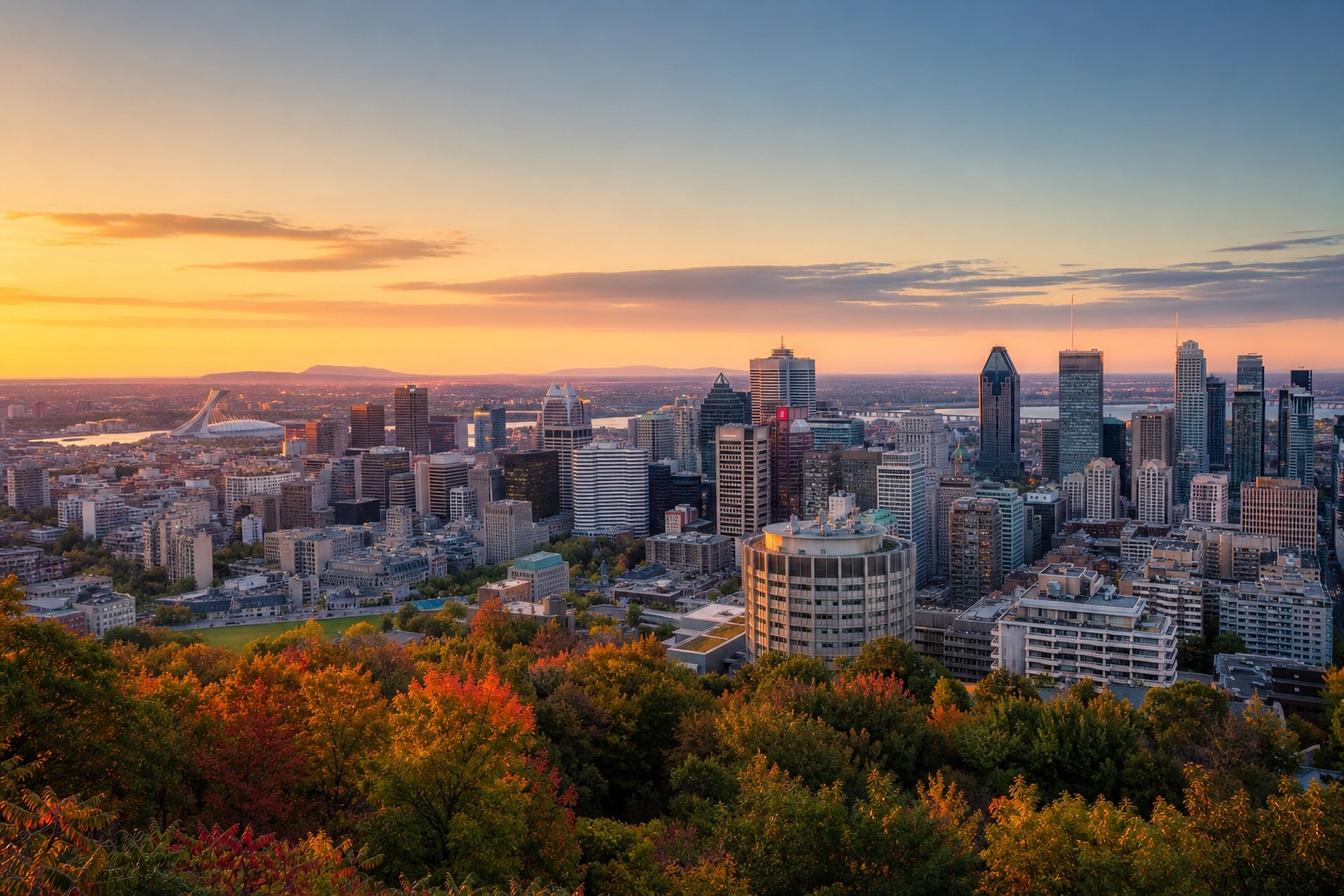
Mont Royal itself is the green lung of the city — you can see its forested hillside from almost everywhere downtown. We didn’t hike to the top (tired legs won that debate), but even from street level, the views of the grand stone buildings nestled against the mountain are striking.


Everything is in French (and That’s Great)

One of the most charming things about Montréal is how thoroughly French everything is. Not in a pretentious way — in a way that constantly reminds you that you’re somewhere genuinely different from the rest of North America. The stop signs say ARRÊT. KFC is PFK — Poulet Frit Kentucky. Five Guys advertises “Hamburgers et Frites.” There’s a fast-casual place called “Vrai Bon Burger.” The neon signs glow in French. It’s a small thing, but it gives the whole city a texture that Toronto or Vancouver simply don’t have.


We wandered through the Plateau and along Saint-Laurent, past old-school shops like La Vieille Europe — a charcuterie and fromagerie that’s been there for over fifty years — and through neighborhoods where the street art is as curated as the food.


Time Out Market

For lunch, we hit the Time Out Market inside the Eaton Centre. If you’ve been to the one in Lisbon, temper your expectations. The Montréal version is essentially a well-curated food court — nice options, decent food, but missing the buzz and character that made the Lisbon original feel like an event. I had Caribbean roasted chicken with plantains over rice and peas. It was good, but at $30 CAD, it was also the kind of price that makes you question your food court life choices. Several of the stalls were closed by 2 PM, which didn’t help the atmosphere.

Still — Time Out Markets are a good concept and worth checking out when you’re in a city that has one. Just don’t expect every location to hit the same level.
The Cloakroom

The highlight of the evening — maybe the trip — was The Cloakroom. Ranked #31 in North America’s 50 Best Bars and #1 in Canada, it’s a speakeasy hidden behind a men’s clothing store called Maison Cloakroom on Rue de la Montagne. You walk through the store, find the hidden entrance, and step into a dark, intimate bar that feels like it exists outside of time.
There are no menus. You sit down, tell the bartender what kind of mood you’re in or what flavors you’re drawn to, and they create something from scratch. Every drink is custom. Every drink is around $25 CAD. And every drink is worth it.


The whole experience is exactly the kind of thing I love about travel — places that don’t try to be everything to everyone, that do one thing with complete confidence. The Cloakroom does cocktails. That’s it. And they do them better than almost anywhere on the continent.
Day 3 — Heading Home
Our last morning was a slow one. Coffee, a casual walk through part of Montréal’s underground city — the RÉSO — which is this vast network of tunnels connecting metro stations, shopping centers, and office buildings beneath downtown. It’s impressive from an engineering standpoint and clearly a lifesaver during Montréal’s winters, but as visitors just passing through, there’s not much to see beyond the concept itself. It’s more a feature of daily life than a tourist attraction.
A flat-rate cab to YUL around noon was painless — the opposite of our arrival experience. Security and U.S. preclearance were quick (Global Entry helped, but the lines were short regardless). We browsed duty free, where I picked up an interesting scotch and tasted a maple bourbon that I ultimately left behind. Then we settled into the Maple Leaf Lounge, courtesy of our United Club membership, and waited for the flight home.

The Verdict
Montréal surprised us. Not because we didn’t expect to like it — we did — but because it felt more foreign than we anticipated. The French language, the European architecture, the food culture, the café-and-speakeasy nightlife — it all adds up to a city that feels like it belongs on a different continent. For a quick two-night trip from the East Coast, it’s hard to beat.
A few things I’d do differently: skip the taxi line at YUL and arrange a private transfer (or at least mentally prepare for the wait). Budget a full day for Old Montréal — we shortchanged it. And maybe book one more restaurant reservation, because the dining scene here deserves more than two nights.
But the smoked meat sandwich at Schwartz’s? The custom cocktails at The Cloakroom? Leigh posing in a Barbie box? Those are the kind of moments that make a trip.
À la prochaine, Montréal.
Where We Stayed: Fairmont The Queen Elizabeth — booked via Amex.com (5x points, $300 hotel credit, complimentary breakfast, $100 F&B credit, suite upgrade)
Where We Ate: Henri (Hotel Birks), Schwartz’s Deli, Time Out Market, Rosélys (Fairmont)
Where We Drank: The Cloakroom (2175 Rue de la Montagne #100)
Getting Around: Taxi from YUL (~40 min wait inbound), walking, flat-rate cab back
Trip Length: 2 nights / 3 days